


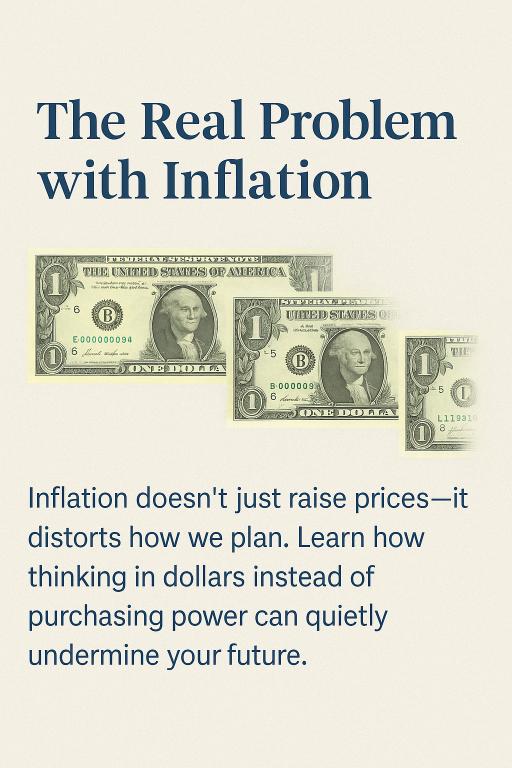
If you’ve been following my recent columns, you know we’ve been exploring the effects of inflation on personal financial planning. In today’s column, I want to focus on the real problem with inflation.
Why Thinking in Dollars Can Be Misleading
Our entire economic system teaches us to think in terms of numbers, not value. We’re conditioned to focus on how many dollars something costs—not what those dollars will actually buy—assuming the dollar holds constant value over time.
If that concept seems fuzzy, let me give you an example.
How Inflation Makes Debt Cheaper
Have you ever taken your house payment, multiplied it by 12 months, then by 30 years, and said, “Wow, I’ll pay back three times what I borrowed”? If so, you’ve fallen into the trap of thinking in terms of numbers of dollars while ignoring their changing value. In reality, inflation causes your money to lose value each year—while your fixed house payment stays the same. So over time, your house payment actually becomes cheaper in real-dollar terms.
Would You Wait 30 Years for $10,000?
Still not convinced? Here’s another way to think about it.
Suppose I handed you a $10,000 gift certificate. You’d probably be thrilled. But now let’s say that certificate can’t be used until the year 2050. Suddenly, it doesn’t seem quite as generous, does it?
Now let’s change the date again—to 1931. That same $10,000 would have bought you an entire house, a new car, and much more. Clearly, the value of money is tied to the year in which it’s spent.
Why Fixed-Dollar Planning Falls Short
Money doesn’t have a constant value. And because the value of money is always changing, many of the financial rules we were taught—rules based on fixed dollar amounts—no longer hold true.
One of the biggest financial challenges we face is planning for the future using today’s dollars. Because we still tend to think in terms of dollar amounts rather than purchasing power, many people discover—too late—that they’ve come up substantially short at retirement.
Your Future Dollars Will Be Worth Less
So here’s the key: Don’t assume your money will buy the same thing in 20 years that it does today.
A $14 movie ticket would’ve seemed laughably impossible to someone in 1969, when tickets were only 50 cents. But it happened.
From 50¢ to $300: Imagining the Future
Now imagine stepping into a time machine and going back to 1969, finding yourself in a movie line. How hard would it be to convince your past self that in 55 years, that same movie would cost $14—or more?
Here’s the twist: You are in that exact same position today.
Can you convince yourself that 40–55 years from now, that same movie ticket could cost $300 or more?
It may sound extreme—but so did $14 tickets from the perspective of 1969.
The Mindset Shift That Changes Everything
That’s why your long-term retirement planning must factor in inflation-adjusted needs, not just today’s prices. What feels impossible now may be inevitable later.
The more you uncover the principles behind the science of financial management, the more you’ll realize that success often requires going against the apparent natural flow. But the good news is, a few small shifts in mindset can lead to massive differences over time.
👉 Don’t let outdated thinking derail your future.
Subscribe to gain insights that keep your plan aligned with reality:
https://billionairecabdriverlife.com/subscribe
📘 Haven’t read Billionaire Cab Driver yet? Get your copy today and start building smarter wealth strategies.
