


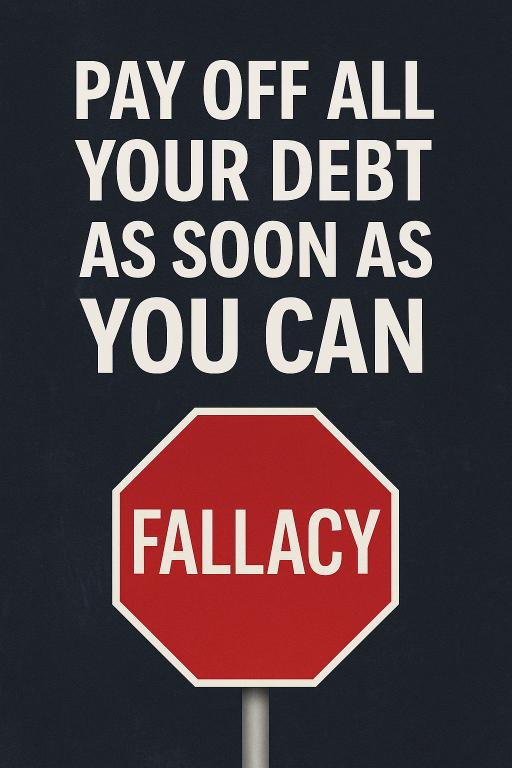
In my last column, we explored Fallacy #1: “The safest place to keep your money is in a savings account.” Today, we turn our attention to a second widely accepted—yet often damaging—piece of advice:
Fallacy #2: “Pay off all your debt as soon as you can.”
You’ve probably heard this from financial “gurus,” well-meaning relatives, and even your mortgage lender. At face value, it sounds wise: who doesn’t want to be debt-free?
But here’s the problem: accelerating the repayment of certain types of debt—especially low-interest, tax-deductible debt—can actually prevent you from reaching long-term goals like retirement or college funding.
Understanding Good Debt vs. Bad Debt
Let’s make one thing clear:
I am not encouraging anyone to rack up credit card debt. That’s the fastest road to financial ruin.
However, not all debt is created equal. The financially educated person knows there is both:
– Good Debt: When borrowing generates a net profit
– Bad Debt: When borrowing produces a net loss
The distinction lies in how the debt is used and what return (if any) the money earns.
The Good Debt / Bad Debt Formula
Debt is justified anytime the net cost of borrowing is less than the investment return you earn with the borrowed funds—plus the long-term benefits of inflation.
Let’s walk through a mortgage example.
Suppose you secure a 30-year fixed-rate mortgage at 4%. Because mortgage interest is tax-deductible and you’re in a 24% tax bracket, the net interest cost is:
4% – (24% of 4%) = 3.04%
Now assume you invest your would-be extra house payments in a 30-year AAA-rated municipal bond earning 3% tax-free. That results in only a 0.04% net loss.
However, here’s the kicker:
Inflation helps borrowers. If inflation averages 2% annually, the dollars you use to repay your mortgage in the future are worth less than those you borrowed.
Add the 2% inflation “gain” to the -0.04% investment margin, and you still achieve a total after-tax, after-inflation gain of 1.96%.
To earn that safely in a savings account, you’d need to find one that pays at least 2.58% after taxes—which is rare.
When Debt Becomes Dangerous
Now let’s consider Bad Debt.
Say you use a credit card to buy clothing at an 18.5% interest rate. That interest isn’t tax-deductible. You don’t invest the money—you spend it. Even with 2% inflation, you’re left with a net cost of 16.5%.
That’s a pure loss.
So, while debt repayment is important, it’s critical to prioritize which debt gets paid off first—and which might serve you better as a financial tool.
The Real Lesson
Most people never consider the cost of being debt-free. They follow blanket rules instead of evaluating actual numbers.
If you have access to low-interest, tax-deductible loans—and the discipline to invest your freed-up cash in long-term assets—you may build wealth faster by extending those loans strategically.
Use the Good Debt / Bad Debt Formula. And always remember: if you skip the investment part, the formula won’t work—because your money isn’t working either.
👉 Think paying off all debt as quickly as possible is always the safest strategy?
Some financial advice sounds right—but doesn’t always hold up when you run the numbers.
Subscribe for weekly insights that challenge common assumptions and help you make more informed financial decisions:
https://billionairecabdriverlife.com/subscribe
📘 Haven’t read Billionaire Cab Driver yet? Discover the principles behind disciplined, long-term wealth building.
